
Many adults who consider autism have already wondered about, or been diagnosed with, other conditions such as ADHD, anxiety, OCD, depression, or trauma-related difficulties.
That is not surprising. There can be meaningful overlap in the way different conditions affect attention, social functioning, routines, emotional regulation, sensory experiences, and everyday life. Autism can also occur alongside these conditions.
A good assessment therefore asks more than whether someone has autistic characteristics. It asks which explanation, or combination of explanations, best accounts for the person’s developmental history and current functioning.
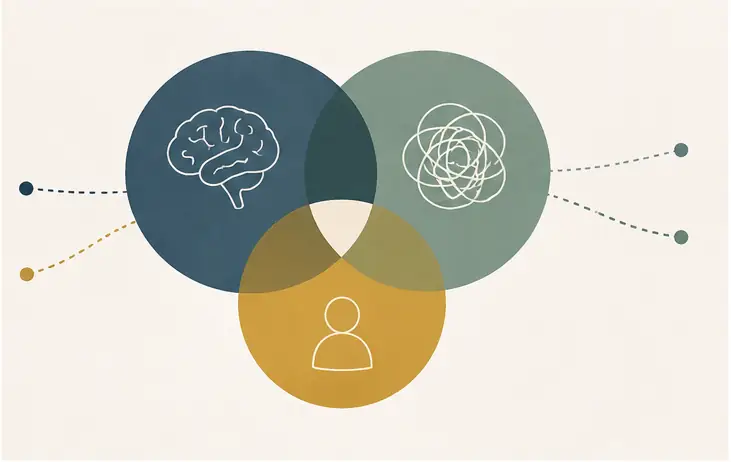
Why Differential Diagnosis Matters
Adult autism assessment can be complicated because many characteristics associated with autism are not unique to autism.
For example, difficulty maintaining friendships could reflect autism, social anxiety, ADHD, trauma, depression, or several factors together.
Repetitive behaviour might relate to autism, OCD, anxiety, habit, or self-regulation.
Difficulty concentrating could reflect ADHD, anxiety, depression, sleep problems, chronic stress, or other factors.
Current clinical guidance recommends that comprehensive adult autism assessment consider possible coexisting and alternative conditions, including other neurodevelopmental conditions, anxiety disorders, OCD, mood disorders, communication difficulties, and physical or neurological conditions.
Autism and ADHD
Autism and ADHD can share several features.
An adult with either condition might describe:
- difficulty with executive functioning;
- problems organizing or initiating tasks;
- intense interests;
- sensory differences;
- emotional dysregulation;
- difficulty managing transitions;
- conversational difficulties; or
- feeling overwhelmed by everyday demands.
However, the underlying pattern may differ.
ADHD is more centrally associated with difficulties involving attention regulation, impulsivity, activity level, and executive functioning. Autism involves a developmental pattern of social communication differences together with restricted, repetitive, or highly patterned behaviour and interests.
The two conditions can also occur together.
This is one reason a clinician should not assume that an existing ADHD diagnosis either explains everything or rules out autism. Adult autism diagnosis is particularly challenging because autism can overlap with other neurodevelopmental and psychiatric conditions.
Autism and Social Anxiety
Autism and social anxiety can sometimes look similar from the outside.
Someone with either may:
- avoid social events;
- find conversation difficult;
- make limited eye contact;
- feel exhausted after interacting with others;
- struggle to initiate relationships; or
- worry about social situations.
The reasons may be different.
A person with social anxiety may understand social expectations relatively intuitively but fear negative evaluation or embarrassment.
An autistic adult may find aspects of social communication less intuitive, rely on consciously learned rules, experience sensory or communication differences, or find the interaction itself unusually effortful.
Of course, an autistic person can also have social anxiety.
The distinction therefore depends on developmental history, internal experience, context, and the broader pattern of functioning rather than one outward behaviour.
Autism and OCD
Autism and obsessive-compulsive disorder can both involve repetitive behaviour, routines, rigidity, and distress when things do not happen as expected.
This overlap can make differentiation difficult.
In OCD, repetitive behaviours or mental acts are typically connected to obsessions, distress, or attempts to prevent a feared outcome.
In autism, repetitive behaviour or routines may serve different functions, such as predictability, enjoyment, sensory regulation, focused interest, or reducing uncertainty.
That distinction is not always simple in real life. Research comparing repetitive behaviour in autism and OCD finds considerable overlap and emphasizes the need to understand the function and context of the behaviour rather than relying only on its appearance.
Autism and OCD can also occur together.
Autism and Anxiety
Anxiety is common across many different psychological presentations and can complicate adult autism assessment.
An anxious person may:
- avoid unfamiliar situations;
- rely heavily on routines;
- seek reassurance;
- become distressed by uncertainty;
- find social situations exhausting; or
- experience sensory environments as harder to tolerate when stressed.
These experiences can resemble aspects of autism.
The clinician therefore needs to understand when the pattern began, what triggers it, what function it serves, and whether broader developmental evidence supports autism.
Autism and Depression
Depression can affect social engagement, motivation, energy, concentration, communication, and everyday functioning.
Someone experiencing depression may withdraw socially, lose interest in activities, struggle with executive functioning, and feel increasingly overwhelmed by normal demands.
If these changes began only during a depressive episode, that pattern would be different from a lifelong neurodevelopmental profile.
However, an autistic adult can also experience depression.
Assessment therefore needs to distinguish longstanding developmental characteristics from changes in functioning associated with mood.
Autism and Trauma
Trauma-related difficulties can affect trust, relationships, emotional regulation, social behaviour, sensory responses, and perceptions of safety.
Some trauma-related behaviours can resemble autistic characteristics, particularly when assessment focuses only on current presentation.
The developmental timeline becomes especially important.
Autism is developmental, so relevant characteristics should be evident earlier in life, even if they were not recognized as autism at the time.
Trauma may also occur in addition to autism, which can make the clinical picture more complex.
Can Personality Be Mistaken for Autism?
Some personality characteristics can overlap superficially with autism.
A person might be introverted, highly structured, socially reserved, unusually focused on particular interests, or prefer predictable routines without being autistic.
Personality disorders can also involve difficulties with relationships, emotional regulation, identity, trust, or social behaviour.
Again, the question is not whether one or two traits resemble autism.
The clinician needs to consider the overall pattern, developmental history, function of the behaviour, and whether the core autism criteria are actually present.
Why Childhood History Is So Important
Developmental history is one of the most useful ways of distinguishing autism from conditions that develop later.
Autism is a neurodevelopmental condition. Adult assessment therefore looks for evidence that relevant social communication differences and restricted or repetitive patterns were present during development, even if they became more obvious only later.
Clinical guidance specifically recommends examining early developmental history, current functioning, mental health, other neurodevelopmental conditions, and sensory sensitivities as part of comprehensive adult autism assessment.
What If More Than One Diagnosis Fits?
That is entirely possible.
An adult might have:
- autism and ADHD;
- autism and anxiety;
- autism and OCD;
- autism and depression;
- autism and trauma-related difficulties; or
- several overlapping conditions.
The purpose of assessment is not necessarily to find one diagnosis that explains everything.
Sometimes the most accurate formulation is that more than one condition contributes to the person’s experiences.
Why Online Checklists Are Limited
Online screening questionnaires can be useful starting points, but they cannot reliably distinguish autism from all the other conditions that may produce similar experiences.
Someone may endorse many autism-related items because of ADHD, anxiety, OCD, depression, trauma, personality, or another condition.
The reverse can also occur. An autistic adult may score lower than expected because of masking, interpretation of questions, self-awareness, or other factors.
That is why screening tools are best understood as one source of information, not a diagnosis.
What Does a Comprehensive Assessment Consider?
A strong adult autism assessment may examine:
- developmental history;
- social communication;
- relationships;
- restricted or repetitive patterns;
- routines and responses to change;
- sensory experiences;
- focused interests;
- masking and camouflaging;
- executive functioning;
- mental health;
- previous diagnoses;
- functional impairment;
- collateral information where available; and
- alternative or coexisting explanations.
The goal is to understand the person as a whole rather than simply matching isolated traits to a checklist.
When Might an Autism Assessment Be Helpful?
An assessment may be useful when someone has a longstanding pattern of social, sensory, behavioural, or developmental differences that has not been fully explained by previous diagnoses.
It may also be helpful when ADHD, anxiety, OCD, depression, or another condition explains part of the picture but important questions remain.
The assessment should not begin with the assumption that autism must be the answer.
It should begin with the question:
What best explains this person’s experiences across their life?
Adult Autism Assessment in Calgary
Adults considering assessment in Calgary can learn more about our Adult Autism Assessment process, including developmental history, standardized assessment tools, masking, differential diagnosis, feedback, and written reports.
For people still wondering whether autism might be relevant, our Signs of Autism in Adults guide provides a broader overview.