
Why Autism May Be Recognized Later in Women
Many autistic women reach adulthood without having been identified as autistic. Some receive a diagnosis in their 20s or 30s, while others begin considering autism much later in life.
There is no single “female presentation” of autism, and autistic women are an extremely diverse group. However, several factors can make autism less readily recognized in some women and girls.
Historically, much of the early research and clinical understanding of autism was based disproportionately on boys and men. At the same time, some girls learn ways of navigating social situations that can make their difficulties less apparent to teachers, clinicians, peers, and even family members.
As a result, an adult woman may have spent many years knowing that certain aspects of life were unusually difficult without having an explanation that adequately accounted for her experiences.
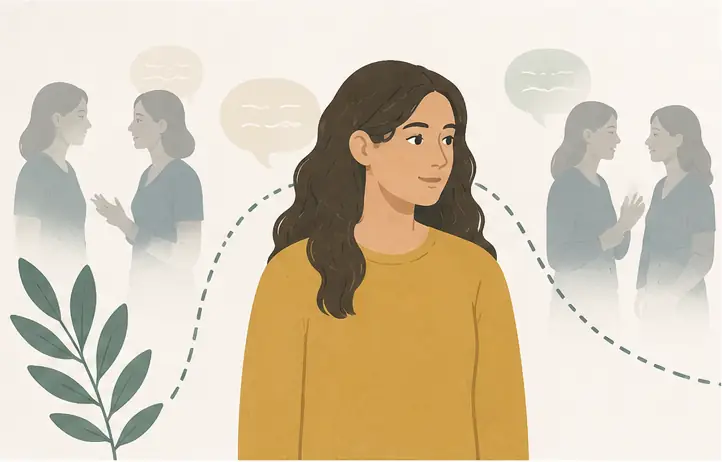
What Can Autism Look Like in Adult Women?
The diagnostic characteristics of autism do not change according to gender. Autism involves persistent differences in social communication and interaction together with restricted or repetitive patterns involving behaviour, interests, routines, or sensory experiences.
How those characteristics appear in everyday life, however, can vary considerably.
Some autistic women describe experiences such as:
- feeling socially different despite wanting friendships and connection;
- carefully observing other people to determine how to behave;
- having a small number of particularly important friendships;
- finding group relationships or changing friendship dynamics difficult;
- rehearsing conversations before they occur;
- analyzing conversations afterwards;
- consciously managing eye contact, facial expressions, or body language;
- becoming exhausted after prolonged social interaction;
- needing significant time alone to recover;
- experiencing strong sensory sensitivities;
- relying on routines or preparation to manage uncertainty; or
- developing interests that are particularly intense or absorbing.
None of these characteristics, by itself, establishes that someone is autistic. They need to be understood within the person’s broader developmental history and functioning.
Masking and Camouflaging
One concept that has received increasing attention in discussions of autism in adults is masking, also called camouflaging.
Masking describes efforts to conceal autistic characteristics or compensate for difficulties in social situations.
For example, someone might study how other people interact, imitate expressions or gestures, develop conversational scripts, deliberately maintain eye contact, suppress repetitive movements, or closely monitor how they are being perceived.
Over many years these strategies can become highly practiced.
This creates an important distinction between social performance and social experience. A person may appear socially capable while internally relying on substantial conscious effort to maintain that appearance.
Masking is not unique to women and is not exclusive to autism. Men and gender-diverse autistic people may also camouflage, and people who are not autistic sometimes consciously modify their behaviour in social situations.
However, masking can be clinically important when considering why autistic characteristics may not have been obvious earlier in someone’s life.
Friendships and Social Development
One misconception about autism is that autistic people do not want relationships.
Many autistic women describe a strong desire for friendship and belonging. Their difficulties may instead involve understanding how relationships develop and change.
Someone might have had one close friend throughout childhood but struggled when that friendship ended. Others may have been able to join groups but felt uncertain about their position within them.
Some women describe consciously learning social behaviour by observing peers, television characters, siblings, or other people they considered socially successful.
These experiences can become increasingly complicated during adolescence, when relationships often involve more subtle expectations, shifting alliances, indirect communication, and increasingly complex social rules.
Interests May Not Look Stereotypically Autistic
Focused interests are another area where autism may sometimes be overlooked.
Autistic interests do not need to involve trains, numbers, computers, or other subjects traditionally associated with stereotypes of autism.
An autistic person’s interests could involve literature, animals, celebrities, psychology, art, music, health, fashion, fictional worlds, history, sport, relationships, or virtually any other subject.
The clinically relevant feature may be less about what the person likes and more about the intensity, depth, persistence, or function of the interest.
An interest that appears socially typical may therefore still form part of an autistic developmental pattern.
Sensory Experiences
Sensory differences can be significant for autistic women but may not always have been recognized as related to autism.
Examples can include strong reactions to:
- clothing textures or seams;
- particular fabrics;
- noise;
- crowded environments;
- fluorescent or bright lighting;
- smells;
- food textures;
- temperature;
- physical touch; or
- multiple sources of sensory information occurring simultaneously.
Someone may have organized aspects of their life around avoiding uncomfortable sensory experiences without necessarily thinking of themselves as having sensory difficulties.
Anxiety, Depression, ADHD and Other Diagnoses
Adults who eventually explore autism often have a history of other diagnoses or mental-health concerns.
Anxiety and depression are common reasons people first seek psychological support. ADHD may also be identified before, after, or alongside autism.
Some autistic adults have also previously been understood primarily in terms of social anxiety, OCD, trauma, eating difficulties, or personality characteristics.
A previous diagnosis does not necessarily mean it was incorrect. Autism can coexist with many other psychological and neurodevelopmental conditions.
The important clinical question is whether the existing explanation adequately accounts for the person’s whole developmental pattern.
For example, social anxiety may explain why someone fears social situations, but it may not fully explain lifelong difficulty intuitively understanding social communication, sensory differences, repetitive behaviours, focused interests, and a strong preference for predictability.
This is one reason comprehensive assessment involves differential diagnosis rather than simply administering an autism questionnaire.
When Success Can Hide Difficulties
Academic or professional success does not rule out autism.
Some autistic women perform very well academically or develop successful careers. Strong language, intelligence, memory, conscientiousness, or expertise in a particular area may provide significant advantages.
At the same time, functioning may be uneven.
Someone could excel professionally while struggling substantially with friendships, household organization, sensory demands, emotional regulation, transitions, or maintaining functioning outside work.
Others manage successfully for many years before experiencing difficulty when circumstances become more demanding—for example, after beginning university, entering the workforce, becoming a parent, taking on management responsibilities, or experiencing major life changes.
Understanding both strengths and difficulties is therefore important during assessment.
Autism and Burnout
Some late-identified autistic adults describe periods of profound exhaustion after years of managing demanding environments or sustaining extensive compensatory strategies.
The term autistic burnout is commonly used to describe experiences of prolonged exhaustion, reduced capacity, increased sensory sensitivity, or greater difficulty managing everyday demands.
Burnout is not itself evidence that someone is autistic. Depression, occupational burnout, chronic stress, physical illness, and other factors can produce overlapping experiences.
However, exploring the circumstances surrounding repeated periods of overwhelm can contribute useful information when considering someone’s broader developmental history.
Does Recognizing These Experiences Mean I Am Autistic?
Not necessarily.
It is very easy to read descriptions of autism and recognize aspects of oneself. Most individual autistic characteristics also occur among people who are not autistic.
Diagnosis involves looking at whether there is a persistent developmental pattern consistent with the diagnostic criteria for Autism Spectrum Disorder and whether another explanation better accounts for the person’s experiences.
Someone considering autism may therefore find it helpful to think about patterns across their entire life rather than asking whether they currently possess a list of particular traits.
Our broader guide to signs of autism in adults explores these characteristics in more detail.
Adult Autism Assessment for Women in Calgary
Women considering an autism assessment in Calgary may wish to look for a clinician who has experience assessing adults and understands both masking and the variety of ways autism can present across individuals.
A comprehensive assessment should consider developmental history, current functioning, social communication, sensory experiences, routines and interests, compensatory strategies, mental health, and possible alternative explanations.
Our guide to adult autism assessments in Calgary explains the assessment process, questions to ask potential providers, and practical considerations for adults exploring diagnosis.