
Recognizing Autism in Adulthood
Autism is sometimes identified during childhood, but many people reach adulthood without having been diagnosed. Some begin wondering about autism in their 20s or 30s, while others do not consider the possibility until much later in life.
There are many reasons autism can go unrecognized. An adult may have developed effective ways of navigating social situations, had strong academic or language skills, grown up at a time when autism was understood more narrowly, or received other explanations for difficulties they experienced.
Some adults first consider autism after a child or family member is diagnosed. Others encounter descriptions of autistic experiences and recognize patterns that seem familiar from their own lives.
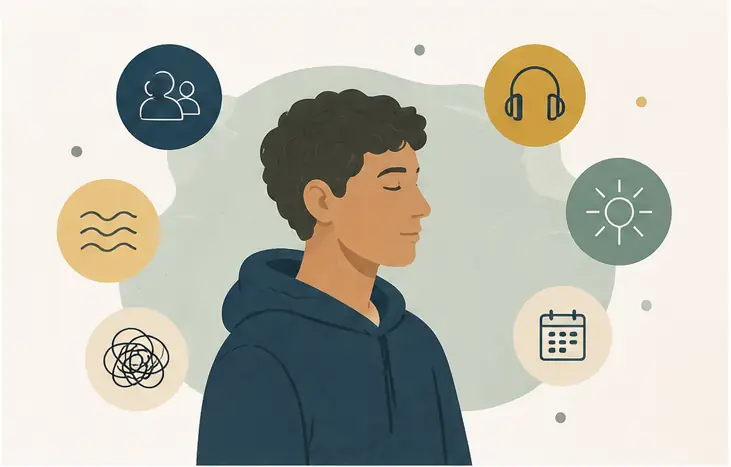
The signs of autism in adults can be subtle, particularly when someone has spent many years adapting to expectations around them. Understanding autism therefore involves looking for patterns across a person’s life rather than identifying one or two isolated characteristics.
Importantly, having some autistic characteristics does not necessarily mean that someone has Autism Spectrum Disorder. Many of the experiences discussed below can also occur in people who are not autistic or can be associated with ADHD, anxiety, OCD, trauma, depression, personality, temperament, or other factors.
Social Communication and Interaction
Differences in social communication are one of the central features considered when assessing autism.
An autistic adult may describe feeling that other people seem to understand social rules intuitively while they have had to learn them more consciously. They might understand social situations intellectually but still find navigating them effortful.
Possible experiences include:
- uncertainty about when to enter or leave a conversation;
- difficulty knowing how much information to provide;
- taking language relatively literally;
- missing hints, implied meanings, or subtle changes in tone;
- difficulty recognizing when another person has become bored or wants to change the subject;
- uncertainty about how to maintain casual friendships;
- finding small talk confusing, unrewarding, or exhausting;
- preferring conversations centred around shared interests or substantive topics;
- replaying conversations afterwards to determine whether something went wrong; and
- feeling socially competent in familiar situations but considerably less certain in unfamiliar ones.
These experiences vary greatly. Some autistic adults are highly verbal and socially engaged. Others speak relatively little or prefer limited social interaction.
The relevant question is not simply whether someone can socialize, but how they experience social communication, how naturally it comes to them, and how much conscious effort may be involved.
Friendships and Relationships
Autistic adults can and do form close friendships, romantic relationships, marriages, and families. Difficulty with social interaction should not be confused with an absence of interest in other people.
However, relationships may have followed an unusual or challenging pattern.
Some adults describe having one close friend at a time rather than belonging comfortably to larger groups. Others report repeatedly losing friendships without fully understanding why. Some find relationships easier when they revolve around a shared activity or interest.
An adult might also:
- prefer a small number of close relationships;
- find group dynamics difficult to follow;
- feel uncertain about expectations within friendships;
- have difficulty initiating contact despite wanting connection;
- rely on other people to organize social activities;
- become intensely focused on particular friendships or relationships;
- need substantial recovery time after socializing; or
- feel as though they are performing a role in social situations.
Again, none of these characteristics alone establishes autism. The overall developmental pattern is what matters.
Masking and Camouflaging
One reason autism may be missed in adulthood is masking, sometimes called camouflaging.
Masking refers to strategies a person uses to conceal, compensate for, or manage autistic characteristics so that they fit more comfortably with social expectations.
An adult might consciously:
- imitate another person’s facial expressions or gestures;
- practice maintaining eye contact;
- rehearse conversations before social events;
- prepare stories or questions to use in conversation;
- study how socially successful people behave;
- suppress repetitive movements;
- avoid discussing interests they fear others will find unusual;
- monitor their facial expression, posture, or tone of voice; or
- create rules for handling common social situations.
These strategies can become so familiar that the person no longer recognizes how much conscious effort is involved.
Someone who masks effectively may appear socially confident during a brief interaction while experiencing considerable uncertainty, anxiety, or exhaustion internally.
This is one reason an adult autism assessment should consider internal experience and developmental history, rather than relying only on how someone presents during an appointment.
Masking has received particular attention in research and discussions about late-identified autistic women. Our guide to autism in adult women explores this in greater detail.
Preference for Routine and Predictability
Some autistic adults have a strong preference for routine, consistency, or knowing what to expect.
This might involve obvious routines, but it can also appear in subtler ways.
Examples can include:
- eating the same foods regularly;
- following particular morning or evening routines;
- completing tasks in a specific order;
- becoming distressed by unexpected changes in plans;
- wanting detailed information before visiting an unfamiliar place;
- mentally rehearsing upcoming events;
- finding spontaneous activities stressful;
- using extensive lists, calendars, or systems to create predictability; or
- needing time to adjust when circumstances change unexpectedly.
A preference for routine is not unique to autism. The intensity of the need for predictability, its history, and its effect on functioning are more informative than the mere presence of routines.

Focused or Intense Interests
Autistic people may have interests that are unusually intense, absorbing, or important to them.
The subject itself does not need to be unusual.
An adult’s strong interest might involve psychology, history, sport, animals, transportation, politics, music, literature, health, technology, collecting, a particular television series, a professional field, or almost any other topic.
What may be distinctive is the depth, intensity, persistence, or role the interest plays in the person’s life.
Someone may spend large amounts of time researching a subject, accumulate extensive knowledge, return repeatedly to the same topic, or find engaging with an interest particularly calming or rewarding.
In some adults, a focused interest becomes an area of professional expertise and may therefore be viewed as a strength rather than a difficulty.
Sensory Differences
Sensory differences are common in autism and can be particularly important when understanding an adult’s everyday functioning.
An autistic adult may experience heightened or reduced sensitivity to:
• Sound
• Light
• Touch
• Clothing textures
• Smell
• Taste
• Temperature
• Pain
• Movement
• Internal bodily sensations
For example, someone might find certain background noises impossible to ignore, become exhausted in brightly lit stores, cut labels out of clothing, avoid foods because of texture rather than taste, or become overwhelmed in crowded environments.
Some people also actively seek particular sensory experiences, such as pressure, movement, particular textures, repetitive sounds, or specific types of visual stimulation.
Sensory differences can influence choices about clothing, food, work environments, transportation, relationships, recreation, and where someone is comfortable spending time.
Repetitive Movements and Self-Regulation
Repetitive movements are sometimes called stimming. They can serve many purposes, including regulating emotion, maintaining concentration, managing sensory input, or expressing excitement.
Examples might include:
- rocking;
- pacing;
- tapping;
- rubbing or manipulating objects;
- repeatedly moving fingers or feet;
- playing with hair;
- repeating sounds or phrases; or
- using particular objects for sensory stimulation.
In adults, these behaviours may be subtle or performed mainly in private. Someone may also have learned to replace noticeable childhood behaviours with movements that attract less attention.
Repetitive movement is not inherently problematic, nor is it unique to autism. Its significance is better understood in the context of a person’s developmental history, other characteristics, and the role the behaviour plays in everyday life.
Autism, Overwhelm, and Burnout
Some autistic adults describe periods in which the demands of everyday life become increasingly difficult to manage. Work, study, relationships, household responsibilities, sensory demands, social expectations, and the effort involved in adapting to different environments can accumulate over time.
When these demands consistently exceed a person’s available resources, some autistic people describe experiencing autistic burnout. The term is commonly used to describe a period of significant exhaustion, reduced capacity, and increased difficulty managing demands that were previously more manageable.
During these periods, a person might notice:
Autistic burnout may involve:
• greater sensitivity to noise, light, touch, or other sensory input
• increased difficulty with conversation or social interaction
• reduced concentration, organization, or executive functioning
• greater reliance on familiar routines and predictability
• needing substantially more time alone or recovering after activities
• everyday tasks requiring considerably more effort
• temporarily having less capacity to mask or compensate for autistic characteristics
For some adults, experiences of burnout are part of what eventually leads them to wonder about autism. Someone who managed relatively well through school, for example, may struggle considerably when university, employment, independent living, parenting, or other adult responsibilities increase the demands placed upon them.
Burnout by itself does not indicate autism. Similar experiences can occur with depression, occupational burnout, chronic stress, ADHD, anxiety, physical illness, sleep difficulties, and many other circumstances. In an autism assessment, the broader developmental pattern and the person’s functioning across their life are therefore important.
Autism Can Look Different in Different People
Two autistic adults may have remarkably different personalities, abilities, interests, careers, relationships, and support needs.
One person might be outgoing and highly verbal while another is quiet. One may strongly prefer routines while another has developed a lifestyle that appears relatively spontaneous. Someone may have obvious sensory sensitivities, while another person’s sensory experiences are much less prominent.
Intelligence also does not determine whether someone is autistic. Autistic people occur across the full range of intellectual ability.
Similarly, professional or academic success does not rule autism out. Some adults develop substantial strengths and accomplishments while continuing to experience significant difficulties in other areas.
This variability is one reason autism assessment involves looking at the pattern as a whole rather than counting superficial traits.
Could These Signs Be Something Other Than Autism?
Yes.
There is substantial overlap between some autistic characteristics and experiences associated with other conditions.
For example:
- ADHD can involve executive-functioning difficulties, social impulsivity, intense interests, sensory differences, and problems regulating attention.
- Social anxiety can make conversations and social situations extremely difficult.
- OCD can involve repetitive behaviours, rigid patterns, and significant distress when particular actions cannot be completed.
- Depression can lead to social withdrawal and reduced functioning.
- Trauma-related difficulties can affect relationships, emotional regulation, sensory responses, and perceptions of safety.
- Personality, temperament, learning history, and life experiences can also influence how someone relates to other people and manages everyday demands.
These possibilities are not mutually exclusive. An autistic adult can also have ADHD, anxiety, OCD, depression, trauma-related difficulties, or other psychological conditions.
This is why a comprehensive assessment asks not simply “Does this person have autistic traits?” but “What explanation best accounts for this person’s developmental history and current experiences?”
When Might an Adult Autism Assessment Be Helpful?
Assessment may be worth considering when someone recognizes a longstanding pattern of autistic characteristics and wants greater clarity about their experiences.
People seek assessment for many reasons. These can include self-understanding, treatment planning, workplace or post-secondary accommodations, understanding relationship difficulties, clarifying previous diagnoses, or determining what types of support may be useful.
Some people decide that formal diagnosis is important to them. Others explore autism primarily as a framework for understanding themselves and ultimately decide not to pursue assessment.
There is no requirement that someone who recognizes autistic characteristics must seek a diagnosis.
For readers considering formal evaluation, our guide to adult autism assessments in Calgary explains how adult diagnosis works, what an assessment may involve, and questions to consider when choosing an assessment provider.